Wednesday, 9 July 2014

Spotlight On: Liverpool


Over the last 30 years Dunbar and Boardman has delivered many projects throughout the world and lots of those have been in the UK.  D & B’s first Liverpool–based project was in the 1980s.  We initially worked with HH + J Robinson (now CBRE) mainly on buildings owned by Equity and Law (now Axa). We also reported and advised on St Johns Tower, again for HH + J Robinson on behalf of the owners Land Securities. We then worked extensively with local agencies such as Edmund Kirby (now Matthews and Goodman) on India Building amongst other sites.

The recent Liverpool Conference was in conjunction with the International Festival of Business successfully organised by UK property forums & Matt Battle. The conference clearly demonstrated how successfully Liverpool has transformed itself.  Once a conventional historic port Liverpool is now a modern commercial city within an industrial fringe.  We wish to congratulate UK Property Forums and Matt Battle for a wonderful conference and Keppie Massie for the tour and dinner themes.

It is also worth pointing out that in addition to these historical projects we have quite a lot of recent and current projects in Liverpool as you can see by the list below:

Recent D & B Projects in Liverpool include:
  • We advised on the John Lewis roll-out programme which included Liverpool and supported WSP on the Liverpool One development.
  • Mersey Tunnels – installed new lift at Wallasey Stores building and a full modernisation of passenger lifts at Wallasey Police and Tolls terminal 
  • University of Liverpool – new install of passenger lift and 1 VPL at LORI Project
  • Belle Vale Shopping Centre – full modernisation of Mall passenger lift
  • Broadgreen Hospital – installation of a bed/passenger lift
  • RBS/NWB Skelmersdale – new bullion lift
  •  The Capital Building (formerly Royal Insurance HQ) modernisation of the main group of lifts.
  • Port of Liverpool Building  - Grade II* listed  – 5 full replacements 2010
  • Cunard Building - Grade II* listed – 6  major modernisations 2005 
  • Maritime Museum – Part of Albert Dock – Grade 1 listed -  hydraulic modernisations 2007
We also handle the Maintenance Management for the National Museums Liverpool which includes the Museum of Liverpool. 


Do you have a current or planned project in the Liverpool area? We would be happy to discuss any such requirements and how we may be able to assist. Please contact us visit our Warrington Office and ask for Vance Cunningham to start the conversation. We look forward to hearing from you.

Liverpool Vision, 10th floor, The Capital, 39 Old Hall Street,   Liverpool, L3 9PP

Wednesday, 2 July 2014

What is Maintenance Management? How do we handle it?


Berkeley Square House


Maintenance Management (MM) is the process of providing specialist knowledge, assistance and support services to those who have a responsibility and/or requirement for ensuring that the vertical transportation systems and processes within their property(s) comply with statutory requirements and operate with maximum efficiency, effectiveness, availability and safety during the core operating times of the businesses and people to whom the equipment is provided. This may be for a single lift or a national portfolio of properties with extensive and varied assets. Whatever the size, number or location, Dunbar & Boardman will tailor the scope of support services to meet these specific objectives and budgets and provide access to our wealth of knowledge, experience and resource to demystify this essential and often critical building function.

Managing and controlling the risks and costs associated with unplanned equipment failure, statutory compliance, the performance and scope of services contracted and delivered by the maintaining contractor. In doing so we are able to obtain optimum life and reliability from the equipment while ensuring that all stakeholders achieve maximum return from their investment and satisfy user expectations throughout the evolution of a property.

Dunbar and Boardman have been implementing MM projects for over 30 years and have refined our processes in that time. What is our approach? Our support services can include;

Maintenance Management Support at D&B

*    Review of maintenance agreement(s) and its suitability and offer alternative options and solutions as may be applicable.

*    Ensure the Contractors compliance with the Servicing Agreement.

*    Site equipment condition appraisals and quality audit visits and reporting to ensure that maintenance quality is upheld, effective and any shortfalls/defects are identified, reported to allow the necessary remedial action to be implemented.

*    Site health and safety and equal access assessments and provide guidance and budget costs to mitigate shortfalls against current Standards and Regulations

*    Catalogue and process LOLER Thorough Examination reports to ensure compliance with statutory obligations. Issue regular status and management planning reports on LOLER Examination dates and provide notification of expiry dates or non conformances requiring action

*    Provide financial planning reports and life cycle assessments.

*    Review and root cause analysis of equipment failures and defects and proposed remedial actions to be implemented

*    Review and validity assessment of maintenance contractor invoices

*    Monitor and review of SLA’s and KPI’s.

*    Coordinate and chair regular Contractor/Client Management meetings. 

*    Review and report when required on any major incident/accident on an installation.

Do you have a current or planned project that would benefit from our expertise? We would be happy to discuss any such requirements and how we may be able to assist. Give us a call on T +44 (0) 20 7739 5093 or send us an email via peterboardman@dunbarboardman.com to start the conversation. We look forward to hearing from you.

Thursday, 19 June 2014

Why use a consultancy for Façade Access and Building Maintenance Units?


Creating Façade Access systems and deploying the correct Building Maintenance Units (BMU) or Mobile Elevated Work Platform (MEWP) is specialised work that requires both project management experience and a detailed knowledge of the technology and technological advances in the industry. The requirements of each building will be different and very often are complex. This complexity is one of the reasons that companies around the world choose to work with a specialist consultancy for Façade Access & BMUs. The other major reasons are listed below.

Planning

The development of a Façade Access solution is a long term process and the building maintenance strategy will be ongoing over the life of the building. It is essential that a maintenance strategy is considered and incorporated into the initial building design and implemented during the construction phases. The maintenance programme and longevity of the equipment must be considered. A consultancy will be able to achieve all of this and enable the facility management team to use the maintenance equipment for a minimum of 25 years.

Efficiency

When creating a schedule of Façade Access and selecting the most suitable solution a key objective will be the need to optimise the usage of the access equipment, as well as the operability of the Façade Cleaning Equipment (FCE).  By choosing a consultancy to manage the process a company reduces the risk of making a poor choice, in addition the consultancy will carry professional indemnity insurance to give further peace of mind.

Bespoke Solutions

If a developer or client were to approach a manufacturer directly there is a real chance that they would be guided into the purchase of one of the manufacturer’s existing product solutions. An evaluation based on the commercial interests of the manufacturer would be undertaken; rather than the comprehensive and unfettered approach taken by a specialist consultancy. Using a consultancy ensures that the best solution will be sought and found.

Independence

A consultancy can set up and manage a formal tender process with 3 or 4 bidders and invite them to submit a tender for the project.  Following post tender evaluation the most appropriate solution and supplier can be chosen. The final decision and award of the contract will be based completely on merit.

Commercial Negotiations

Consultancies are aware of industry norms and charging rates and therefore have a stronger hand when it comes to negotiating commercial contracts. Using a consultancy could save you money in the short and long term. Naturally the possibility and scope of any saving can only be assessed on a case-by-case basis.

Industry & Legislative Standards

A consultancy will be able to create façade-cleaning solutions that minimize the impact on building design and meet the highest safety according to EN standards. Furthermore they will be able to ensure that the equipment is provided within International Quality & Safety Standards and that health & safety requirements for the particular environment are met.

Dunbar and Boardman is a specialist consultancy that has provided global clients with bespoke solutions for façade access equipment and BMUs for over 30 years.

Do you have a current or planned project that would benefit from our expertise? We would be happy to discuss with you. Give us a call on T +44 (0) 20 7739 5093 or send us an email via peterboardman@dunbarboardman.com to start the conversation. We look forward to hearing from you.


Wednesday, 11 June 2014

Why do you need an elevator & escalator equipment consultancy? 6 reasons.


Dunbar and Boardman is an elevator & escalator consultancy that has provided global clients with bespoke solutions for vertical or horizontal transportation and access equipment for over 30 years. Why have so many companies chosen to work with a specialist consultancy? The key reasons are listed below.

Independence

If you were to approach an elevator or escalator manufacturer the solution to your project is likely to be presented in the form of one of their products. A consultancy can take an impartial overview and recommend the best solution for your project’s needs.

Experience

We have a wealth of practical experience working on a number of projects similar to the one that you are about to start. You will be able to tap into our experience and complete your project efficiently safe in the knowledge that we have completed many similar projects. For example, we have the biggest pool of lift experience in the UK.


Systems

We have workflow systems and procedures in place that we have refined over the last 30 years. Our systems and the professional relationships we have with lift companies at the highest management level mean that you can transfer any ‘risks’ to the experts and of course we carry Professional Indemnity Insurance.


Technology & Industry Knowledge

We proactively keep up to date with technological advancements within the vertical transportation industry. This is why we are able recommend the right technology and supplier for your project. We also follow relevant changes in legislation to ensure that projects remain compliant with all applicable standards and legislative requirements.


International Scope

We are operational throughout the UK, Europe, The Gulf, Asia & India, and have consultants available to manage your projects. We have successfully delivered projects in 30 countries worldwide.


Maintenance

Once your project has been completed we can manage maintenance and technical support throughout the life of the lifts.

Do you have a current or planned project that would benefit from our expertise? We would be happy to discuss with you. Give us a call on T +44 (0)20 7739 5093 or send us an email via peterboardman@dunbarboardman.com  to start the conversation. We look forward to hearing from you.


Wednesday, 4 June 2014

What have we done to enable Equality Access?


The Equality Act of Ist October 2010 replaced the Disability Discrimination Act of 1995 and requires service providers to make changes, where needed to improve service for disabled customers or potential customers. Within the vertical transportation industry this often means making changes to existing buildings to enable better access and considering access requirements during the planning stages of a project. Almost 10 million people in the UK are identified as having a disability and are protected from direct discrimination and harassment. Also protected are those who are mistakenly thought to be disabled and those who experience discrimination because of their association with a disabled person. Dunbar and Boardman have worked on another number of projects where the brief was to facilitate improved access for disabled customers. The Millennium Bridge Inclined Lift also known as the Millennium Inclinator is a good example of this type of project.

What was the project challenge?

There was already a lift on site – one that was frequently out of service due to electro-mechanical breakdowns. The doors were a particular concern as the lift arrangement has entrances on opposing sides of the car, which means coupling the doors conventionally is complex and was a major contribution to unreliability on the original lift. 

What was the solution?

Due to the planning restriction the doors had to be glazed and the operator mounted on the underside of the car. The solution involved the first time the application of this type of Wireless Sematic door system being installed in this configuration. Due to space restrictions the lift was delivered in three stages from Germany then stored locally before being brought to site as needed, due to the limited space available. The lift was completed before the Golden Jubilee River Festival weekend.

What were the results?


In March 2014 an in-house report commissioned by the City of London the Millennium Inclinator was reviewed and it confirmed that there had been a general improvement of ‘in service’ time in the period up until January 2014.  The report also set out plans for future improvements and detailed processes for ordering spare parts.

Are you currently considering equality access for a project you are working on? We would be happy to discuss with you. Give us a call on T +44 (0)20 7739 5093 or send us an email via peterboardman@dunbarboardman.com to start the conversation. We look forward to hearing from you.

Wednesday, 28 May 2014

Vertical Transportation & Energy Efficiency


How has the vertical transportation industry responded to society’s demands for energy efficiency?

In recent years elevator and escalator manufacturers have embraced society’s demands for energy efficient or ‘green’ products with many innovations. These innovations within the industry have enabled manufacturers and their clients to reduce energy consumption and the carbon footprint of the buildings in which they are contained in many cases. Technological improvements have been adopted quickly across the industry.  Below we have listed 6 significant recent innovations in the vertical transportation industry..


1. Solar Powered Lifts
Perhaps the most newsworthy of relatively recent developments was the introduction of the completely Solar Powered lift by Schlinder in 2013. Solar powered lift systems can potentially be utilised throughout the world and particularly on the continent of Africa and in the Middle East. The solar powered lift can deliver an energy saving of up to 50%.


2. Escalators and Passenger Conveyors in Sleep mode
Escalators and passenger conveyors can be fitted with a passenger sensing device for automated operation that enables the escalator to activate sleep mode (also referred to as standby mode) when there is no passenger demand.


3. Lifts in Standby mode
The same process can also be applied to lifts. For example, the power side of the lift controller and other operating equipment such as lift car lighting, user displays and ventilation fans switch off when the lift has been idle for a prescribed length of time. 


4. VVVF Control
The lift uses a drive controller capable of variable-speed, variable-voltage with variable-frequency (VVVF) control of the drive motor.


5.  Regenerative Features
Lifts fitted with regenerative features are those that convert the energy generated from the lift motor driven by gravity into electricity for other uses. Compared to older lifts, regenerative lifts are 20-30% more energy efficient. These are also described as lifts with a regenerative overlay.


6.  Energy Efficient Lighting with LED technology
LED lighting runs for up to 50,000 hours and is a modern, cost-effective alternative to incandescent or fluorescent lighting that uses 90% more power. The light quality is brighter and superior improving visibility. Additional energy-saving options include lights that switch off when the lift is not occupied, and a dimmable feature allowing passengers to adjust the level of lighting inside the lift-car.


Would you like to discuss energy efficiency measures for your building? Are you working on a project that would benefit from greater energy efficiency? Please give us a call on T +44 (0)20 7739 5093 to discuss or send us an email via peterboardman@dunbarboardman.com to start the conversation. We look forward to hearing from you.

Wednesday, 21 May 2014

What are the benefits of Destination Control?

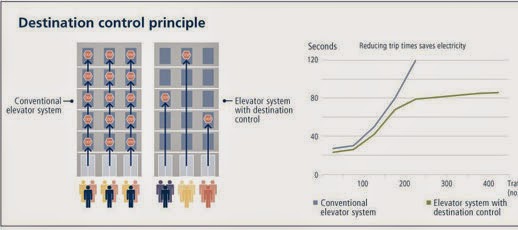
We have all been into a building where there seems to be an excessively long wait for an elevator at the lobby. Most likely the building in question is not utilising a Destination Control system. Destination Control is a traffic management system for lift passengers that groups passengers and their destinations and then selects the most efficient lift car for their journey.  Destination Control can be installed in new buildings and significantly can also be applied to existing buildings too. The key benefits of installing a Destination Control system are listed below.
 
1. Waiting times are reduced. 
Waiting times can be reduced and the passenger experience improved. Crowded lobbies with passengers speculating on the arrival time of the next lift car can become a thing of the past.

2. Quicker journeys
People travelling to similar destinations share a lift and this results in quicker journeys across the board.  Your journey to the 18th floor is no longer delayed by passengers travelling only one or two floors, for example.

3.  Fewer stops
Intelligent grouping of the destinations means that each elevator journey will have fewer stops than a random approach would have and therefore the lift car can return to the ground floor or another floor if a shuttle system is being deployed.

4. Easy to operate
A Destination Control System is very easy to operate via a keypad in the lobby.

5. Can reduce the need for lift shafts by 25% 
Installing a Destination Control System can reduce the need for lift shafts by 25% in some cases. This could represent a huge financial saving for developers of new buildings and is a very good reason why lift specialists should be involved in the initial stages of commercial building design.

6. Energy Efficiency
Smarter use of elevators via a Destination Control system can result in greater energy efficiency in some cases. There will be more time when the lifts are not being used.

Dunbar & Boardman has extensive experience of Destination Control projects as you can see by clicking here

Would you like to install Destination Control in your building? Are you working on a project that would benefit from Destination Control? Please give us a call on T +44 (0)20 7739 5093 to discuss or send us an email via garyavis@dunbarboardman.com to start the conversation. We look forward to hearing from you.